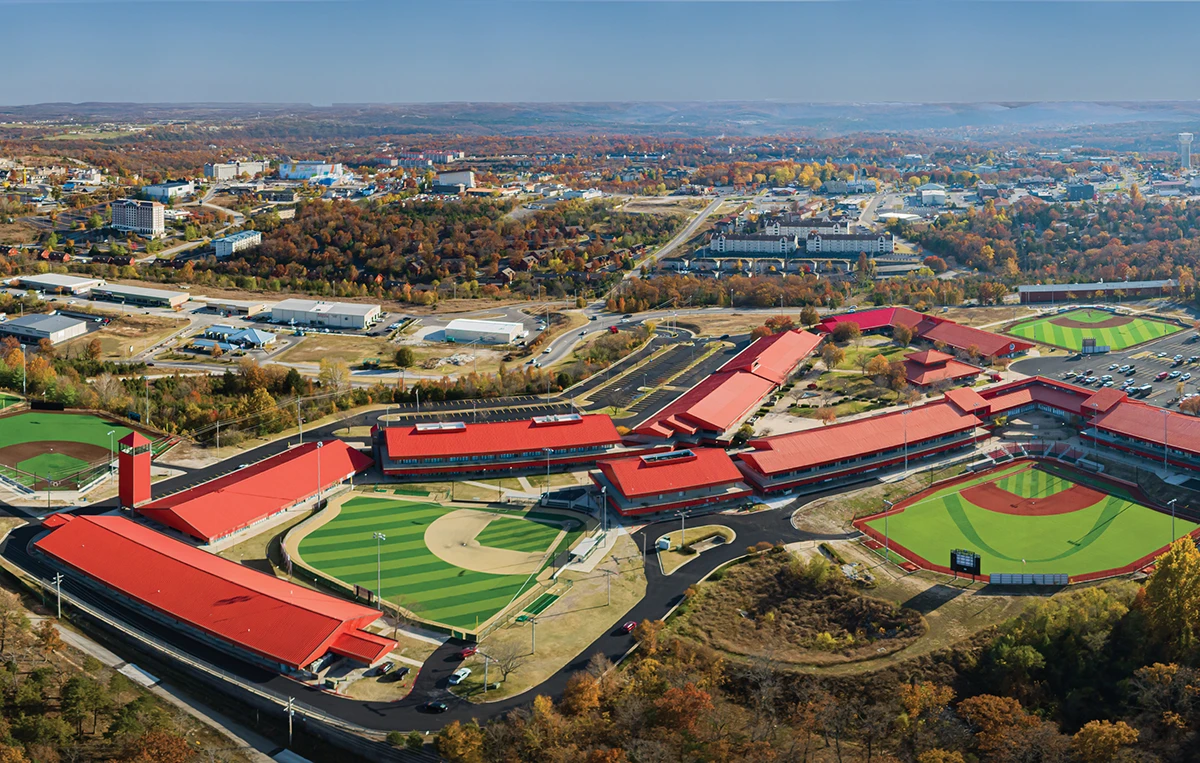
Courtesy Ballparks of AmericaIn 2025, more than 800 teams played at Ballparks of America, operated by Greg Snider, Paul Satterwhite and Steven Strobel.


With families spending upwards of $18,000 a year on travel sports and organizations like Heart of America Tournaments and Ballparks of America drawing hundreds of teams to the region, youth sports have become a powerful economic engine.
May 2026
If the future of sports tourism in 417-land is still taking shape, one piece is firmly established: youth sports.
The average U.S. sports family spent $1,016 on their child's primary sport in 2024, a staggering 46% increase since 2019, according to research from the Aspen Institute. Notably, this rate is twice that of economic price inflations in the U.S. during the same time period. Also, that figure accounts solely for straightforward fees such as team registration and the price of equipment; it doesn't include any travel costs. Factoring those in, annual spending on one child's primary sport can easily extend into the five-figure range. SportsEpreneur estimates that a family spends as much as $18,000 annually on travel and associated costs.
Multiply that across dozens, sometimes hundreds, of teams traveling for a single event, and the impact adds up fast: hotel stays, eating in restaurants, shopping, entertainment. Or, just as easily, and just as impactfully, those dollars leave the region. That's the opportunity. And the risk.
Beyond sports fields and other facilities, the region is seeing substantial growth in the events themselves.
Organizations like family-owned Heart of America Tournaments (HOAT) bring a steady stream of competition to the area, from weekend volleyball tournaments to national baseball events. In February 2026 alone, HOAT hosted three weekend volleyball events at Allison Sports Town, bringing in 65 to 70 teams each weekend. This June, the organization will host 32 baseball teams from eight states for the AABC 18u Connie Mack World Series Qualifier, one of only seven of these qualifiers in the country.
In March 2026, Springfield also hosted the National Christian HomeSchool Championships in basketball, drawing 416 teams for a full week.
Paul Satterwhite, one of four owners at Branson's Ballparks of America, who's also on the Branson Chamber Board of Directors and a partner at Spencer Fane, shared that Ballparks hosted just north of 800 teams in 2025 tournaments. Right at 90% of those teams were from out of the area, meaning more than 75 miles away, so they slept in hotels and primarily ate at restaurants and did activities in the Branson area.
These aren't small gatherings. They're multi-day events that fill hotels, restaurants and venues to capacity across the region, bringing in substantial tax dollars. And they're just a slice of the broader picture, which also includes often-overlooked sectors like fishing tournaments and archery competitions—events that quietly generate significant traffic.
Branson offers a glimpse of what's possible when a city fully embraces sports tourism. Playeasy.com, often called "LinkedIn for sports" and one of the largest digital networks for sports tourism and sporting event organizers, ranked Branson in its 2025 top five trending sports destinations. The platform dubbed Branson "a winning sports destination" and called it "America's wholesome and affordable family entertainment capital."
Kristina Hagey, Director of Sports Sales & Development at Branson/Lakes Area Convention & Visitors Bureau, was not surprised by Playeasy's ranking.
"We are unique because we are a tourist destination, in addition to having some very well-designed sports facilities," she says. "I know when people think of Branson, they often think live entertainment, lakes, family attractions, but we really have another powerful story with sports tourism in our destination."
That story is paying off. In spades. Hagey says, "In 2025, Branson wrapped our year with just under 150 sporting events, of which more than 40 were brought to our community by our CVB and our sports department." These included a vast range of events, from local cheerleading competitions to larger events like Missouri state archery [Missouri National Archery in the Schools Program (MoNASP)] championship, held in March, that brings in more than 4,000 archers from across the state.
Those 2025 events generated more than $70 million in estimated economic impact. Ballparks of America contributed another $25 to $27 million throughout southwest Missouri, solely in baseball tournaments.
"Families and their athletes travel for tournaments and compete, not just in games, but they're staying in our hotels, dining in our restaurants, visiting our attractions and shopping," Hagey says. "In most cases, they're extending their stay to experience everything Branson has to offer. That sports tourism brings year-round visitation and new audiences. It has a meaningful economic impact into our community."
That combination—sports plus entertainment—is hard to beat. "This area is going to thrive when it comes to youth sports," says Greg Snider, one of Satterwhite's Ballparks of America partners. "There are so many areas where they're trying to do this—building the facilities, trying to grow…but there's not a lot else to offer in the community. They're going to have a tougher time competing with areas like ours that have so much else to offer in addition to the sporting event itself."