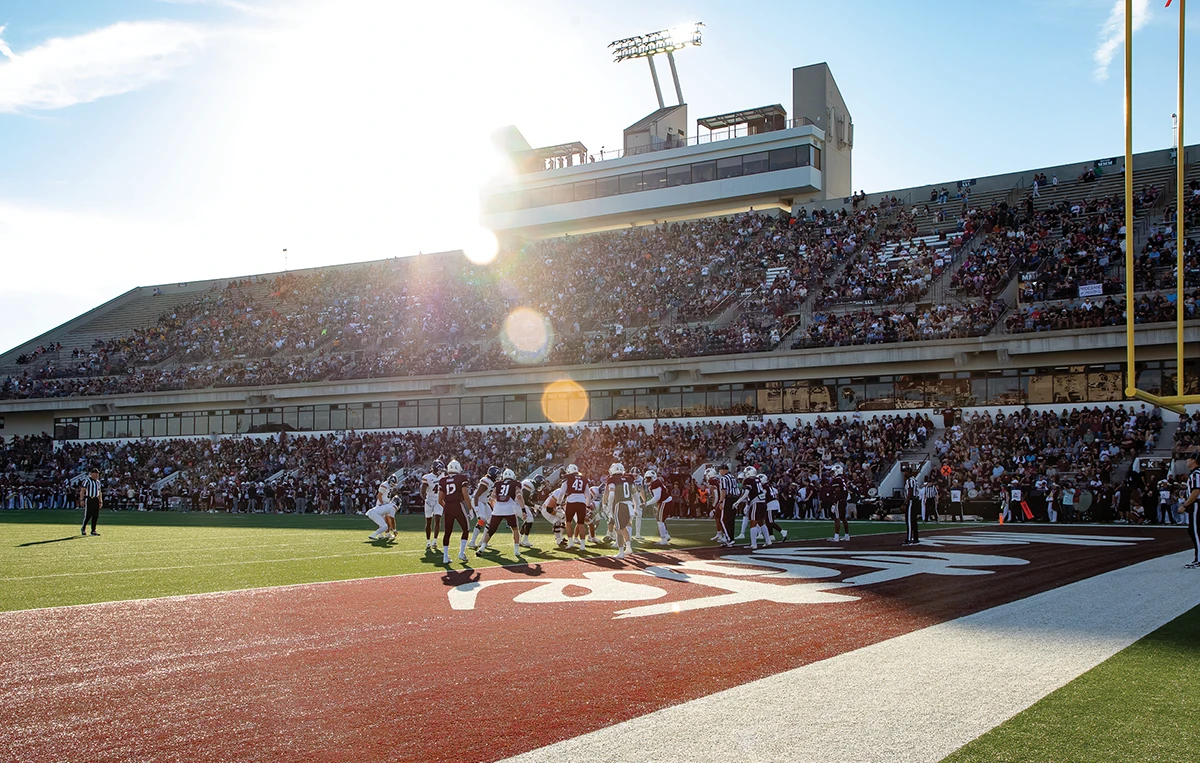
Karen Knuth PhotographyRecent improvements at Plaster Stadium include a new playing surface with state-of-the-art artificial turf and enhanced fan amenities.
Purchase Photo

Missouri State University's leap to Conference USA and the Football Bowl Subdivision is bringing national broadcasts, rising enrollment goals and NIL deals worth millions—putting Springfield on the map in ways that extend far beyond the field.
May 2026
Missouri State University recently stepped into a new era in terms of its athletic programs. The Bears officially joined Conference USA in July 2025, transitioning from the Missouri Valley Conference and moving into the Football Bowl Subdivision—the highest level of NCAA Division I competition.
One of the biggest benefits of that shift is that it comes with increased national visibility. Certain home games played at Robert W. Plaster Stadium will be broadcast nationwide on ESPN platforms and CBS Sports Network. Especially noteworthy, the Bears' schedule now includes Tuesday, Wednesday, Thursday and Friday games in October, whereas it was always traditionally Saturdays only. Likewise, Missouri State University Athletics Director Patrick Ransdell says there has been an increase in game attendance, with the stadium up by a few thousand season ticket holders per game.
Ransdell also says that this will likely have a positive impact on enrollment at the university. "With our strategic plan taking shape, our goal by 2030 is to have 30,000 students," he says. "So our exposure and [athletics] being the front porch of the university will enhance all of that and allow us to hit all those metrics that we've laid out there."
That kind of exposure extends far beyond the field, shaping perception, recruitment and long-term economic potential. New teams coming into town means more new visitors and, in turn, more new tax dollars coming into the Springfield area.
Another aspect to college athletics is NIL (name, image and likeness). Relatively new at the university level, the NCAA only introduced NIL policies in 2021, allowing student-athletes to commercially control how their image is used. In other words, they can receive compensation for appearances, endorsements, social media content and more.
Rising stars like Jackson Cantwell, a standout Nixa athlete, top football recruit and the top-ranked 2026 offensive tackle in the entire country, command NIL deals worth millions. While he and his family haven't made a public statement about it, Cantwell's deal was reportedly worth over $2 million a year—one of the highest to date in college football.
That kind of money, and again, exposure, doesn't just reshape individual players or even college athletics as a whole. It raises the profile of entire communities, putting places like Springfield and its surrounding areas into national conversations about recruitment and talent development.